AIML in the LLM Era: The Deterministic Layer Your Chatbot Architecture Forgot
LLMs & Foundation ModelsAI & Machine LearningEvery LLM chatbot architecture of the last two years reinvents three things: a canonical intent layer, a guardrail that answers before the model improvises, and an eval loop that feeds missed queries back into content. The Artificial Intelligence Markup Language had all three in 2001, expressed as XML tags, running in constant time per matched word. This is not nostalgia — it is a design review you can run against your own stack.
AIML in five minutes
An AIML bot is a pile of categories — stimulus, response, and two optional context slots:
<category>
  <pattern>WHAT IS YOUR UPTIME SLA</pattern>
  <template>99.9% monthly. See <a href="/status">status page</a>.</template>
</category>
Input is normalized on the way in: uppercased, punctuation stripped, contractions expanded. Two optional slots add memory when you want it: the <that> slot matches the bot's own previous sentence — enough context to tell YES answering Do you want a refund? from YES answering Anything else? — and the <topic> predicate gates whole blocks of categories on a subject the bot set earlier. That is the entire conversation model: input, one turn of bot memory, one topic variable.
The template is a small programming language: conditions, random choice of reply variants, predicate set/get, and recursion.
The Graphmaster: matching that scales with words, not rules
At load time, every category is folded into a single tree — the Graphmaster — by concatenating the input pattern, the that pattern and the topic pattern into one path. Matching is depth-first with backtracking, and exact words live in hash tables, so a precise hit costs O(1) per input word regardless of whether the bot has 4,000 or 400,000 categories.
What makes the design robust is the strict wildcard priority ladder:
$word   →  explicit override (wins against everything)
#       →  0+ words, highest wildcard priority
_       →  1+ words, high priority
word    →  exact match
set     →  membership in a named set
^       →  0+ words, low priority
*       →  1+ words, lowest priority
Because _ outranks *, a handful of boilerplate categories can catch a keyword at any position in the sentence and reduce it to a canonical form. The recursion tag that does the reducing is <srai> — the spec itself admits nobody agrees what the acronym stands for — and it is the direct ancestor of every intent-normalization step in modern NLU pipelines:
<category>
  <pattern>DO YOU KNOW WHAT * COSTS</pattern>
  <template><srai>WHAT DOES <star/> COST</srai></template>
</category>
About half of a production bot's categories use it — most of them just to fold phrasing variants onto canonical intents. The other half are the answers.
The loop you already run, named in 2001
AIML's development workflow was called Targeting: the bot logs every input that fell through to a fallback; a human reviews the log ranked by frequency and writes the missing categories. Substitute "conversation traces" and "fewer deflections," and you have the eval/iteration loop every LLM product team runs today — except AIML's version had two properties the LLM loop lacks: every fix was a deterministic, version-controlled content edit, and every output was traceable to a specific category with an author and a timestamp.
That traceability is why AIML survived in exactly the niches where generative models are weakest:
- Compliance answers that must never vary ("we do not store your card data") — a template cannot hallucinate a different policy.
- Zero-latency tiers — greeting, small talk, FAQs answered from the tree while the LLM handles the long tail.
- Cost — the tree answers for free; published hybrid rule-first/LLM-fallback prototypes report token reductions around 80%.
- Brand voice — approved copy is the only copy.
- Testability — you can unit-test an AIML bot's exact responses, which no stochastic decoder permits.
The hybrid that actually ships
The pattern that works in production is rules-first, generation-second:
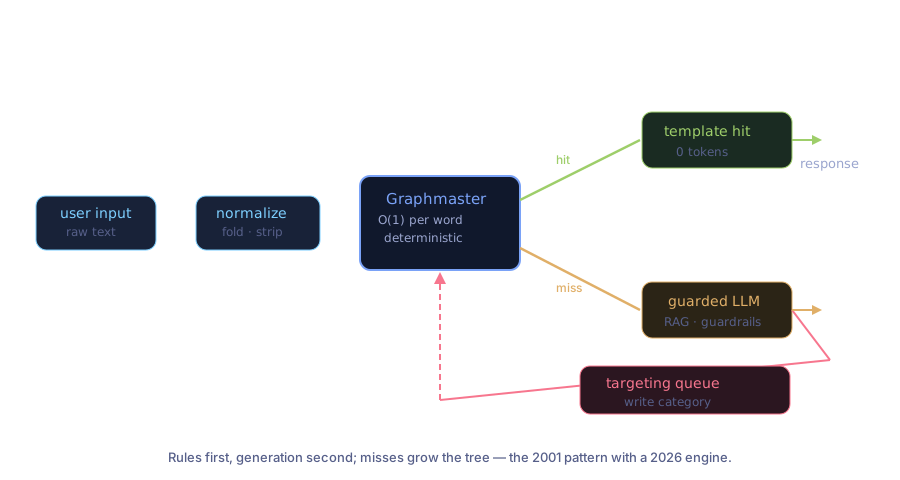
- Normalize the input (the same folding, casing and expansion AIML did).
- Match against the deterministic tree. On a hit, return the template — no model call, no tokens, no latency beyond parsing.
- Fall back to the LLM on miss, wrapped in your guardrail prompt, RAG context, and output validation.
- Log the miss into a targeting queue. Triage by frequency: write a category, or fix the guardrail, or accept the tail.
The interesting design question is where to draw the line. Anything contractual, regulated, or frequently asked belongs in the tree. Anything open-ended belongs behind the model. The mistake is putting the LLM in front and letting it paraphrase your refund policy in a thousand creative ways.
What to run today
The ecosystem is smaller than it was but alive: program-y (Python, maintained, full AIML 2.0 incl. sets, maps and sraix), Program D (Java, the reference line), assorted pyaiml forks for simple loads, and RiveScript as a younger cousin with cleaner syntax if you don't need AIML compatibility. The ALICE A.I. Foundation's AIML 2.1 specification is the standing reference.
Budget honestly before adopting: pattern coverage grows combinatorially with phrasing variety — the canonical failure mode of the era was bots needing 60,000+ hand-written categories to feel competent, which is precisely the gap deep learning closed. The modern case for AIML is not "replace the model." It is: the top decile of your traffic is repetitive, contractual, and latency-sensitive — serve it deterministically, and let the model spend its tokens where variation actually lives.
Verdict
If your architecture has an intent catalog, a guardrail layer, and an eval loop, you have rebuilt AIML's skeleton with more degrees of freedom. The old language still earns its keep as a reference design: it forces the questions that matter — which utterances must never reach a stochastic path, who owns the canonical answer, and what happens on a miss — into artifacts a reviewer can read.